|
These programs demonstrate that rewarding prevention is both practical and achievable. This approach should become standard practice throughout the workers' compensation industry.
Why This Matters
Workers' compensation plays an essential role after a serious injury or death. But no benefit can fully restore a life lost or erase the long-term consequences of a catastrophic injury. One of the system's greatest opportunities is to prevent tragedy before it occurs by rewarding employers who invest in proven protection.
That opportunity exists inside real financial constraints: with approximately $4 billion in annual workers' compensation premiums from the roofing industry supporting claims, operating expenses, and investment returns, there are strong financial and institutional incentives to maintain the status quo. Yet some insurers are beginning to reward employers who invest in proven fall protection. They recognize a simple principle:
The best workers' compensation claim is the one that never happens.
Rewarding prevention protects workers, lowers costs, and creates a stronger workers' compensation system for everyone.
The Human Cost
Each year, falls are the leading cause of accidental workplace deaths in the construction industry, claiming approximately 400 lives. The approximately 11,000 serious fall injuries¹ each year contribute to chronic pain, extended work disability, opioid exposure, and other factors associated with an increased risk of drug overdose and suicide.² In 2020, there were 13,645 drug overdose deaths among construction workers—the highest of any major industry.³ Construction also experiences more than 5,000 suicides each year,⁴ making injury prevention not only a safety issue, but also a critical public health issue.
Multiple peer-reviewed studies and federal public health agencies have documented associations between serious occupational injuries, chronic pain, extended work disability, and opioid exposure following workplace injuries, and increased risks of drug overdose and suicide.5
Improving physical safety alone cannot solve every part of these problems — but it is a meaningful place to start. Preventing serious injuries can reduce the physical, emotional, and financial burden placed on construction workers and their families.
If you or someone you know is struggling, contact the 988 Suicide & Crisis Lifeline or the Construction Industry Alliance for Suicide Prevention (CIASP).
Today's Safety Technology Has Changed
When OSHA's residential fall protection rule became effective in 1995, major residential construction organizations, including the National Association of Home Builders (NAHB) and the National Roofing Contractors Association (NRCA), argued that conventional fall protection was often infeasible on residential sloped roofs.6
In response, OSHA issued Interim Directive STD 3.1, allowing alternative methods of fall protection while those concerns were reconsidered. Those alternative methods often did not require physical fall protection.6
Today, innovative fall protection systems provide suitable anchor points, protect installers, prevent dangerous swing falls, and avoid damage to finished roofs. Still, workers' compensation policies largely reward injury history, not advances in injury prevention. It's time that changed.
Reward Prevention
Not every fall protection system provides the same level of protection. Truly OSHA-compliant systems protect installers7 and prevent dangerous swing falls8. Systems that do not damage the roof are more likely to be used.
Examples include:
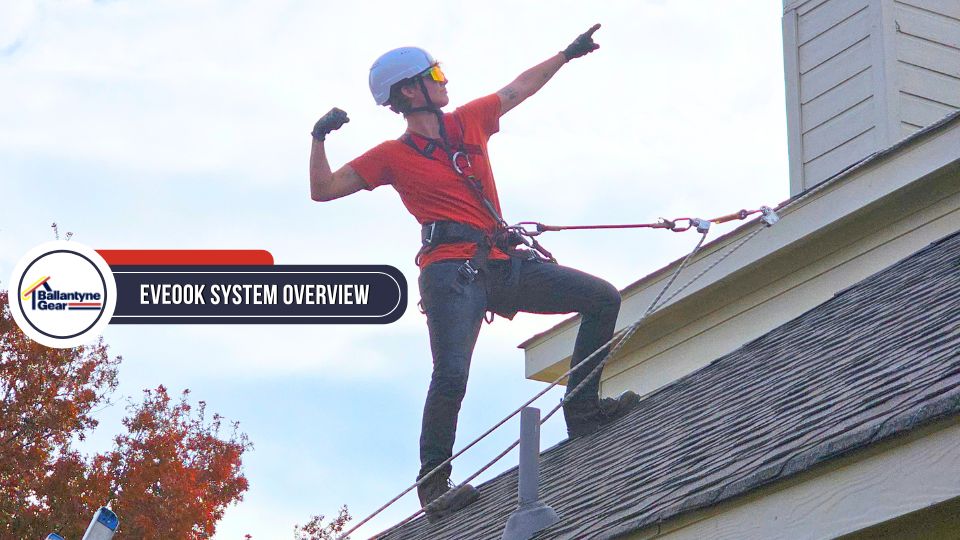
• Ballantyne Gear Eveook Anchor Line Fall Protection System
• Malta Dynamics X-Series Grabber Mobile Fall Protection Crane
• Safety Pole Horizontal Lifeline System... and more
The initial investment in better fall protection may be higher, but fewer serious injuries should lead to fewer claims. In a system that rewards measurable risk reduction, safer workplaces should earn lower workers' compensation costs.
That's already happening and we want to help connect you to resources to protect your people and your profits.
We're building a public registry of insurers and state funds rewarding prevention — the three above are just the start.
[ Browse the growing list → ]
Ask your insurer directly: "Do you offer any discount or grant for OSHA-compliant fall protection?" If the answer is yes, you just found savings. If the answer is no, ask them why not, and let them know others already do. Direct them to the registry.
Already an Eveook customer?
Visit our Certifications page.
Send or download the documentation to bring straight to your insurer — our ANSI Z359.6-16 certification as an engineered fall protection system and view the engineering specs. Make your case and show our Eveook System as a proven, compliant system to OSHA & CSA requirements.
We're not an insurer. We're not a state fund. We don't make a dime whether you switch, negotiate, or stay exactly where you are. We built this because rewarding prevention should be the standard every employer can expect. And we want to help your business be rewarded for investing in a safer culture.
If you're a workers' compensation provider already doing this, you deserve to be known for it. Visit the registry by clicking below and submit your program and we'll get you in front of the employers looking for exactly what you offer.
This is just the beginning. We know there are more programs out there we are just geting started — if you know of one, tell us.
Share this email and link to the registry — on your socials, with your broker, with the next contractor you talk to. This is how an industry actually changes: not from the top down, but one person deciding to pass it along.
Together, we can help business owners and contractors protect workers while encouraging workers' compensation providers that reward prevention rather than waiting for injury.
Protect your people. Protect your profits.
-With Ballantyne Gear.
References
¹ U.S. Bureau of Labor Statistics (BLS). Employer-Reported Workplace Injuries and Illnesses. Approximately 11,000 construction workers suffer serious injuries (hospitalization, amputation, or loss of an eye) each year.
² Boden LI, Asfaw A, O'Leary PK, Tripodis Y, Busey A, Applebaum KM, & Fox MP. Opioid-related mortality after occupational injury in Washington State: accounting for preinjury opioid use. Occup Environ Med. 2024;81(10):515–521. Workers with lost-time injuries experienced substantially higher opioid-related mortality than workers with medical-only injuries, even after accounting for preinjury opioid use.
³ Centers for Disease Control and Prevention (CDC), National Institute for Occupational Safety and Health (NIOSH), and CPWR – The Center for Construction Research and Training. Analysis of National Vital Statistics System data found 13,645 drug overdose deaths among construction workers in 2020—the highest number and rate of any major U.S. industry.
⁴ CDC National Violent Death Reporting System (NVDRS); CPWR. Construction experiences more than 5,000 suicides annually, among the highest of any major U.S. industries.
5 Applebaum KM, et al., Mortality among Workers with Lost-Time Occupational Injuries in New Mexico, 1994–2000, American Journal of Industrial Medicine; National Institute for Occupational Safety and Health (NIOSH), Opioids in Construction; NIOSH Construction Program.
6 OSHA Instruction STD 3.1 (1995); OSHA Residential Fall Protection Frequently Asked Questions; OSHA fall protection regulations (29 CFR 1926 Subpart M).
7 OSHA, 29 CFR Part 1926, Subpart M—Fall Protection, including §§ 1926.501(b)(13) and 1926.500(a).
8 OSHA, 29 CFR § 1926.502(d)(16)(iii), Fall Protection Systems Criteria and Practices.
|